
Official City Release
The built legacy of pioneering architect Marshall Sanguinet
Mentioned Entities
Analysis
Overview
Marshall Robert Sanguinet (1859-1936) practiced architecture for 44 years, with his firms credited with more than 1,800 buildings across Texas and the nation.
Historic Preservation
Development & Land Use
Insights by Role
Developer
MediumMedium significance — notable action worth trackingThe Neil P. Anderson Building's conversion to upper-floor condominiums with ground-floor restaurant and retail demonstrates a completed adaptive reuse model for Sanguinet-era high-rise commercial stock in downtown Fort Worth. The planned Convention Center redevelopment adjacent to the Flatiron Building signals growing civic investment at the southern end of downtown.
Journalist
MediumMedium significance — notable action worth trackingThe Fort Worth Club at 306 W. Seventh St. reached its centennial in 2026, having been completed in 1926 — a timely local story. The article also places the reimagined Fort Worth Convention Center directly adjacent to the historically significant Flatiron Building, raising a defensible question about whether historic design review was triggered.
Resident
LowLow significance — routine or procedural itemThe article provides a self-guided tour of five surviving Sanguinet structures accessible in Fort Worth, including four downtown commercial buildings and his personal residence in the Arlington Heights neighborhood at 4729 Collinwood Ave.
Source Text
Open source →
Standing on nearly any corner in downtown Fort Worth, it’s difficult to look around and not feel the architectural impact of Marshall Sanguinet.
Over the 44 years that Marshall Robert Sanguinet (1859-1936) practiced architecture, his firms were responsible for more than 1,800 buildings throughout Texas and the nation.
Sanguinet moved to Fort Worth in 1883 and practiced architecture here with a variety of partners until the turn of the century.
The longest running partnership, Sanguinet and Staats, rapidly developed one of the state’s largest architectural practices. They produced buildings of all types, from factories and large hotels to churches and schools. The firm is best known for its contributions to the design of steel-framed skyscrapers. Almost every tall building constructed in Fort Worth before 1930 — and for a time the tallest structures in Beaumont, Houston, Midland and San Antonio — were designed by Sanguinet and Staats.
The firm worked in a variety of styles and forms that transformed the scale and style of the state’s rapidly growing cities. In addition to large commercial buildings, Sanguinet and Staats also designed a number of impressive residences, especially on Fort Worth’s tony Pennsylvania Avenue, where examples still stand.
Road trip!
Hop in and let’s take a spin around Fort Worth to view some of Sanguinet’s most prominent works.
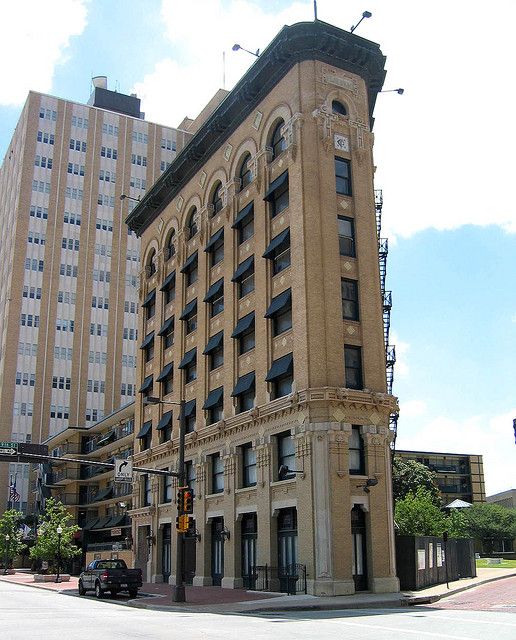
Photo: The Flatiron Building on the southern end of downtown: (Photo: Downtown Fort Worth Inc.)
Flatiron Building, 1000 Houston St. It’s the only true flatiron building in Texas and one of the most recognized in the city. It was built in 1907 for $70,893 using the principles of the Chicago School, in which architects used steel-frame construction to support tall buildings. The building is located on an odd, triangular lot at the intersection of Houston and Ninth streets and Jennings Avenue. In a couple of years, its new neighbor will be the reimagined Fort Worth Convention Center.

Photo: The Neil P. Anderson Building is listed on the National Register of Historic Places and is a Recorded Texas Historic Landmark.
Neil P. Anderson Building, 411 W. Seventh St. This site, located where Seventh Street curves, acts as a gateway to the central business district. Neil P. Anderson operated a cotton brokerage firm from the building. It was built in 1921. With a curving façade overlooking Burnett Park, the 11-story building has distinctive terra cotta ornamentation. Crane your neck skyward to see medallions depicting bales of cotton, stems of grain, garland swags and urns atop the parapet wall. Today, pricey condos occupy the upper flowers, with restaurants and retail on the ground level.
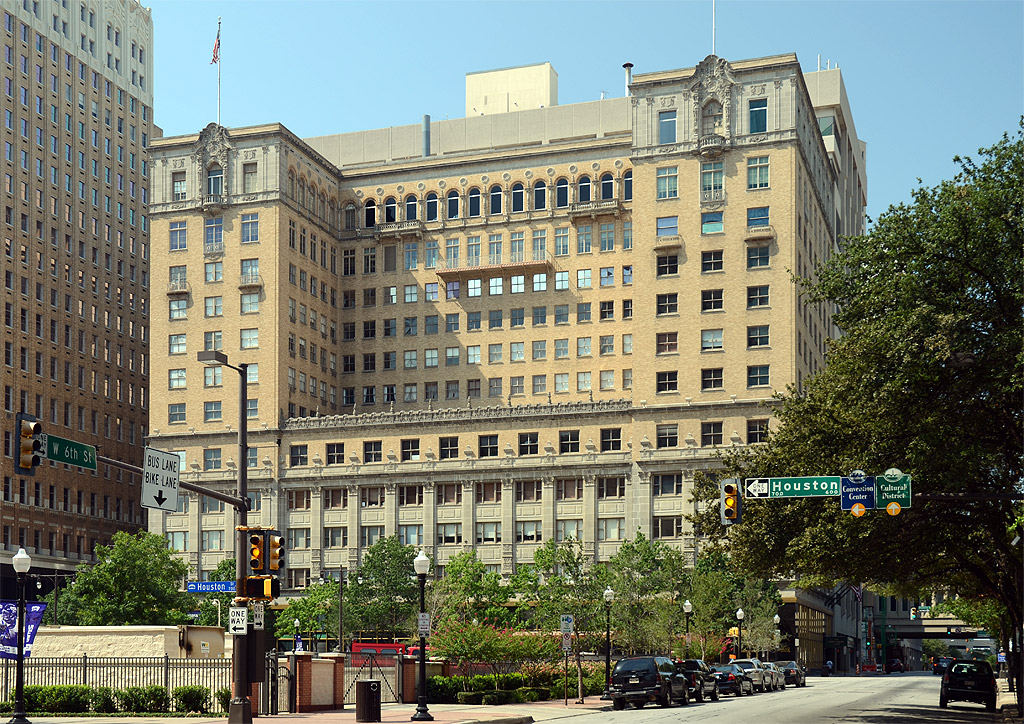
Photo: Since its completion in 1926, the Fort Worth Club building has served as a hub for the city’s business and social elite.
Fort Worth Club, 306 W. Seventh St. The building, celebrating its centennial this year, is unique in that it has a rectangular two-story base (now remodeled) with a four-story transitional section above, then becomes U-shaped above the sixth floor. Furniture retailer Fakes & Co. was the original tenant of the six-story base of the building until 1946, when dry goods store R.E. Cox & Co. occupied the space until 1955. The Fort Worth & Denver Railway occupied the middle part of the U-shaped tower. Today, the Fort Worth Club occupies the upper floors, which include a small hotel for members in the southern wing. In 1975, a 14-story addition was constructed on the half-block site to the west, where the Worth Hotel and Worth Theater once stood.

Photo: Sanguinet’s home is a two-story residence showcasing a blend of Arts and Crafts and Queen Anne influences. (Photo: By Byrd M. Williams. Portal to Texas History/UNT)
Sanguinet home, 4729 Collinwood Ave. Sanguinet built for his family the first home in the new Arlington Heights subdivision, along with 20 or so others between 1890 and 1893. An asymmetrical facade features a 1½-story brick tower and a five-sided, hip-roofed dormer. Remaining in the Sanguinet family until 1948, the interior of the house has been renovated by subsequent owners.

Photo: In this 1970 shot, the ground level of the Knights of Pythias Castle Hall housed Radio Center Record Shop and other retailers. (Photo: HistoricStructures.com)
Knights of Pythias Castle Hall, 315 Main St. This is the second fraternal hall on the downtown site. An 1881 building burned in 1901 and was replaced by this Sanguinet-designed structure. The red brick Castle Hall is a striking building with a steeply gabled slate roof, corner turret and truncated side gables. A niche at the center of the front gable holds an iron knight, a 7-foot-tall suit of armor complete with helmet and shield.
Sanguinet died at his Collinwood Avenue home on July 25, 1936.
(To learn more about these structures – and many more Fort Worth treasures – look into Carol Roark and Byrd Williams’ outstanding book, Fort Worth’s Legendary Landmarks, available at the Fort Worth Public Library.)
Get articles like this in your inbox. Subscribe to City News.
The text and media above are reproduced from the original source for purposes of government transparency and public information under fair use. All content remains the intellectual property of its respective authors and publishers. This reproduction does not imply endorsement by or affiliation with the original publisher. For the authoritative version, please refer to the original source.
Municue is in beta
Tell us what would make press release pages more useful for your workflow.