
Official City Release
Fort Worthian made scoop of the century with frozen favorite
Mentioned Entities
Source Text
Open source →
Happy National Ice Cream Month! Nothing says summer like a big ol’ waffle cone topped with a scoop or two (or more!). Luscious, creamy and frozen just-so, it’s a classic treat that helps beat the Texas heat. But nothing says annoying like a double-decker delight melting and dripping onto your shirt faster than you can say, “brain freeze.”
Did you know the remedy for that cone conundrum was born here in Fort Worth? Not only did it solve a sticky situation for ice cream lovers across the country, but it remains a staple product in residential freezers everywhere.
A happy accident
It was 1928, and I.C. Parker worked as president and general manager for Fort Worth-based Pangburn Ice Cream & Candy Co. (Sweet, right?!) One day — and who could blame him? — Parker had a hankering for an ice cream cone. Although it’s not recorded for posterity, we can only imagine Parker ambling about the factory as he enjoyed his frozen treat.
Perhaps he took a detour to the assembly line to watch as Pangburn’s famous Millionaires candies were being made. Maybe he was checking on production. But somehow, during his meanderings, Parker managed to drop his cone into a vat of chocolate.
It was after rescuing his lost snack, setting it down on a counter and getting chopped-up peanuts stuck to the chocolate that Parker realized his mishap might be marketable.
Solving a “cone-undrum”
I.C. and his brothers J.T. (“Stubby”) and Bruce hatched a plan to mass-produce and sell prepackaged ice cream cones. No fuss, no muss — just open the package and get licking!
Brilliant, right? After putting their prototype to the test, they discovered the cones became too soggy before they could be shipped to sellers.
Undaunted and smelling sweet success, the siblings met with Ohio State food scientists, who devised a way to coat the inside of the cone with chocolate to create a moisture barrier and keep it crisp. Problem solved!
Their concept was simple yet light years ahead of its time. Instead of being assembled and served to customers on the spot, this innovative ice cream cone could be frozen, wrapped, shipped and sold ready-to-eat in grocery stores.
I scream, you scream, we all scream for … Drumsticks!
Legend has it that when I.C.’s wife, Jewel, saw the final product, she said the chocolate-and-peanut-covered cone resembled a fried chicken drumstick.
The Drumstick — and the novelty cone market itself — was born.
Texas roots, national reach
Four months after its namesake product appeared on the market, the Drumstick Co. began scooping up loyal customers in other states, starting with California.
Over time and with many different flavors and formats, the Drumstick brand grew into one of the most recognizable frozen desserts in the United States. In 1937, I.C. and Jewel hired renowned Texas architect Charles Stevens Dilbeck to design a home for them near TCU and Colonial Country Club. The Fort Worth residence featured a rounded turret that many people have described as resembling an upside-down ice cream cone. The home still stands today.
In 1947, the company was acquired by the Lone Star Ice Cream Co., which later merged with several other companies to form Southwestern Dairy Products. In 1991, the brand was purchased by Nestlé, which continues to produce Drumsticks today and sell them to ice cream aficionados across the globe.
Of course, with a name like “I.C.,” it seems written in the stars that he and his brothers would end up creating an iconic ice cream treat enjoyed by generations.
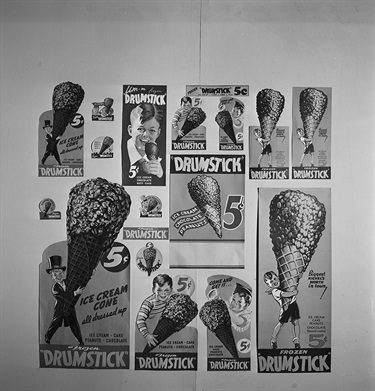
Drumstick advertising posters, 1945. University of Texas at Arlington Libraries, Special Collections.
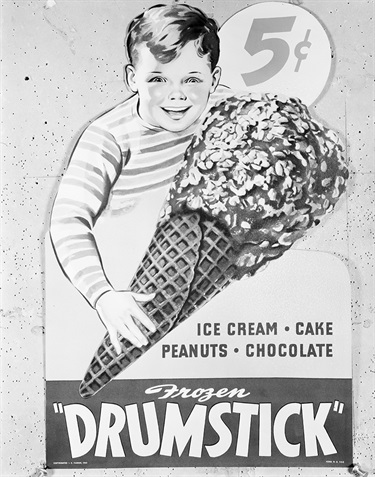
Poster of boy holding a Drumstick, 1947. University of Texas at Arlington Libraries, Special Collections.
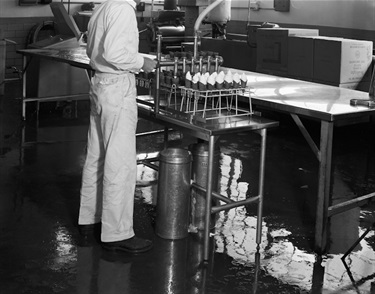
The Parkers didn't have a nationwide manufacturing and distribution network, so they licensed the Drumstick recipe and trademark to regional dairies around the country. Boswell Dairies of Fort Worth was one of those licensed producers. University of Texas at Arlington Libraries, Special Collections.

Drumstick Inc. headquarters at 3320 W. Vickery Blvd. University of Texas at Arlington Libraries, Special Collections.

"I love Drumsticks" advertising poster, 1955. University of Texas at Arlington Libraries, Special Collections.
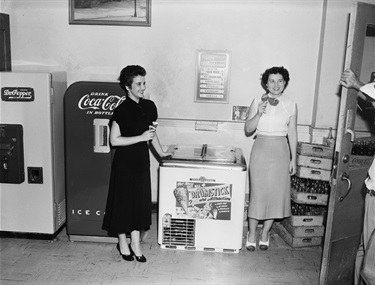
Women standing by Drumstick icebox, 1951. University of Texas at Arlington Libraries, Special Collections.
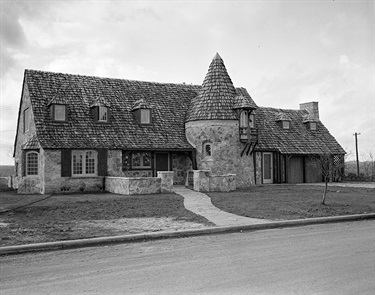
I.C. and Jewel Parker’s Fort Worth residence, 1938. Note the cone-shaped turret. University of Texas at Arlington Libraries, Special Collections.
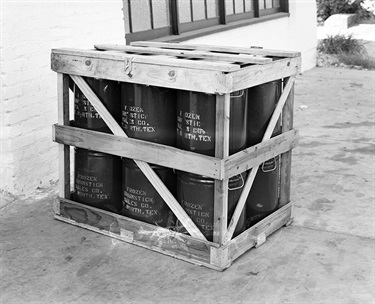
Crate of frozen Drumsticks, 1947. University of Texas at Arlington Libraries, Special Collections.
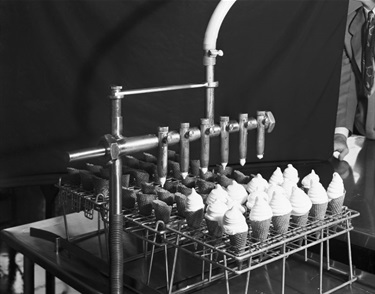
Boswell Dairies manufactured and sold Drumsticks in North Texas for many years. University of Texas at Arlington Libraries, Special Collections.
Get articles like this in your inbox. Subscribe to City News.
The text and media above are reproduced from the original source for purposes of government transparency and public information under fair use. All content remains the intellectual property of its respective authors and publishers. This reproduction does not imply endorsement by or affiliation with the original publisher. For the authoritative version, please refer to the original source.
Municue is in beta
Tell us what would make press release pages more useful for your workflow.